| Bergama
|
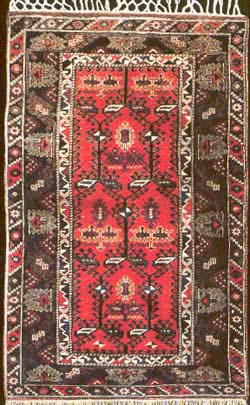
Bergama
is a little town in northwest part of the country, here there
are approximately eighty villages which weave Bergama carpets.
This ancient city was one of the most powerfull and richest
region in Anatolia. The history of carpet waving in this
region has a very old background. Bergama carpets have always
been woven as wool on wool material combination while wefts
are all red. Knoting density of these rugs is about 12 knots
per square cm. and mostly come in three - four square meter
sizes. Those woven in Canakkale are slightly larger. Motifs
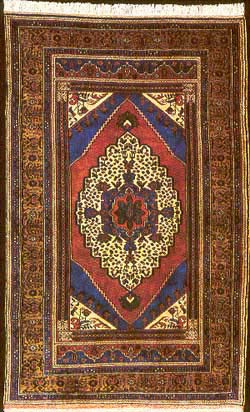
can be divided by two main groups: as Kozak type and Turkish
type. Kozak type rugs have big geometrical designs, these ones
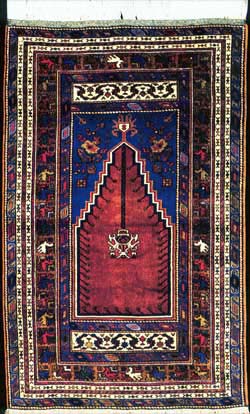
remind Kozak - Gendje region rugs. In Turkish type usually
designs are very floral and emroydreyed with leaves of the
pine trees. They consist mainlyof two colours, the dark reds
and blues. In these rugs red colour, which is used for dyeing
the wool yarns, makes the pile less thick than the rest of the
surface after a certain time, so blue motifs appear higher.
The evil eyes that you see at the edges give them an
exceptionally unusual appearence. |
|
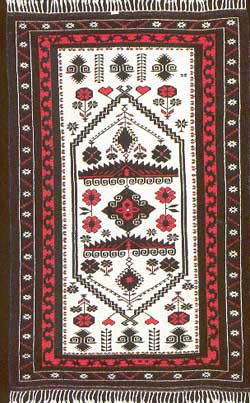 |
Ladik
| Ladik
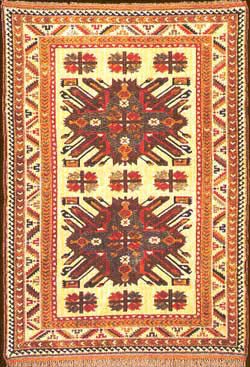
is a town located north of Konya in the hearth of Anatolia.
The main sources of income in this area are animal
husbandary, agrigalture and carpet production. Konya and
Ladik are the oldest carpet making centers in Turkey. Even
during the 15th. center the art of carpet weaving florished
in Konya becouse it was the capital of the Seljuk Empire and
a very important cominication and political center. There
are many notible at works an konya and perhaps the most
famous in the Green Mosque. From Arabia, Iran and other
countries many artists came to Konya to practice their
crafts. The surviving carpets of this era offer ample
evidence of the Turkish character. During this same period
carpet weaving skils pread from Konya to other parts of
Anatolia. The colours in Ladik carpets are very vivid and
vell matched. After Kula carpets, Ladik carpets, with their
250,000 knots per square meter, are considered just as fine |
|
 |
.
Kayseri
|
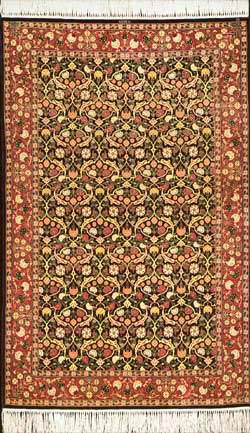
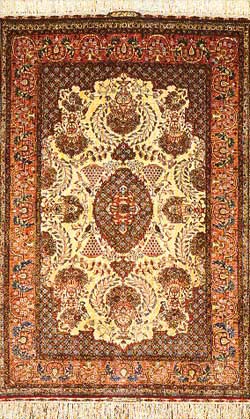
The
town of Kayseri, situated in central Turkey, has been
famous as a carpet making center for centuries. Carpets
and Kilims of Kayseri are of various types. Silk carpets,
artificial silk and wool (floss), natural wool (no dyes),
and Bunyan carpets are the major categories produced.
Kayseri carpets are woven both at the workshops and in the
homes. Weavers usually buy yarn from shops and after
finishing their carpet wolud sell it to the same shop in
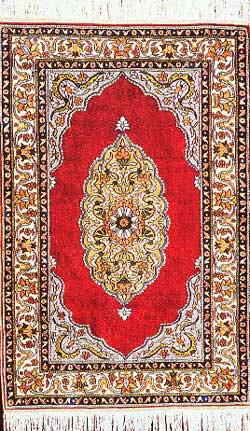
ordar to buy more yarn. The Kayseri floss carpets with
silk looking yarns in bright colours, have found favour
with Europeans with their attractive designs. They look
very much like silk carpets to foreigners. The sizes,
designs and number of knots are the same as Bunyan carpets,
but the large sizes are rather rare. In the floss carpets
chemical dyes are used, because the yarn (floss) can only
be dyed with chemicals. Cotton is used as warp and weft
and floss is used for the knots. This carpets are
considered the masterpieces of Kayseri and as such are
sought out by dealers to sell to the foreign trade.
Sometimes Kayseri carpets are woven entirelly in silk and
will have 600,000 to 700,000 knots per square meter. |
|
| Bunyan
carpets are offen in floral designs of a typical Oriental
carpet. The yarn is cotton and wool dyed with wegetible
dyes, and about 120,000 to 150,000 knots per square
meter.The Kayseri Bunyan carpets are made in different
sizes; from pillow sizes of 62 by 100 cm. to the large 16
square meters carpet. Kayseri natural wool carpets have
all the properties of Bunyan carpets execpt there are not
as many colours used as in the Bunyan carpets. Colours of
white, cream, light and dark brown and sometimes black are
used in this types of carpets with the same number knots
as in the Bunyan carpets. |
|
 |
|